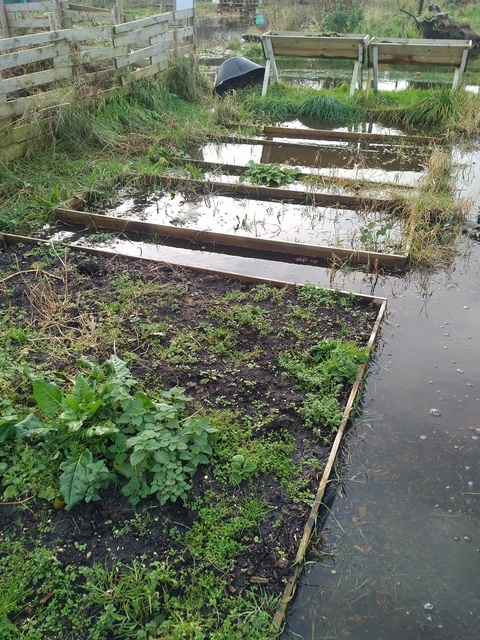
I would like to be able to power up the allotment for the purposes of running Wildlife Cameras and possibly a Weather Station.
There are a number of issues with wiring up an off-grid environment. Fortunately I have a repository of information about just such a thing to draw upon. The main issue is all around generating power, storing said power and of course, using it. Then throw in the final stage... communications.
Generating Power
The obvious choice for this is Solar power, after all, it's not as if I could get the allotment wired into the mains. Fortunately I do have a 12V solar panel. The obvious choice for this is to mount it inside the greenhouse to protect it against the wind and rain. This panel was originally intended to keep my car battery charged up, so it's not the most powerful. But it should be sufficient to power the plot, given that the computers intended to be used here are low powered.
Of course there is the issue surrounding the voltage. The panel produces 12V, but most of the electronics are rated at 5V, so there is definitely a need to step down the voltage in some manner. Now I also have a car adaptor designed to do just that. One of the benefit of stepping down the voltage, is that it also increases the current available.
Storing Power.
The quandary here is at what level do we store the charge? Should be use a spare car battery and store the charge at 12V, or do we use a battery power pack and store the charge at 5V. The main issue here is that to store the charge at 12V we would need additional equipment in the form of a charge controller to manage the battery correctly. This is obviously a bit more expensive. There is also the issue with having nasty lead/acid hanging around the plot. Not something which is nice to have. Also I think it might be against the allotment regulations. Alternatively I could go for a sealed gel battery, or one of the new lead/carbon batteries, but these seem like expensive options.
Never mind, I could instead choose to use a 5V battery power pack for the systems in question, simply because the necessary charge control is usually built in. However there is a further complication in that we would need to have a battery pack that will accept the incoming charge without question, and also be able to discharge without further involvement. Many smaller battery packs have an "on" button to deliver the charge to the devices in question, obviously this is not acceptable as we would need the system to be able to supply the charge to the device, and charge up independently of any inputs. So finding the right kind of battery pack is a must.
"Always on" power packs are few and far between. For safety's sake most disconnect the output when the cells are being recharged. What is needed is something dedicated to intermittent charges, as well as electronic usage. The only reliable format I have found is the Voltaic power packs. Reliable. Do the job. Just a tad expensive.

Using Power.
Finally we need to use the power by the end devices. A continuous supply is necessary to power the computing devices. An intermittent supply could probably be used by the mobile phone/router. So perhaps that device could be charged directly from the solar panel, and the computers via a rechargeable battery pack?
Communications.
Once you start generating data, no matter what type of data it is, you need to be able to use it. That either means a storage system where you can go and get the data as and when required, or better yet, a way to transmit it to the Internet and store it offsite. The easiest answer to this is to use a mobile phone with a data plan. The best option for this would be an Android phone with a data plan SIM. There is no need for phone calls to/from the plot, but a small data plan is obviously something which would be needed. It simplifies things immensely. The phone itself could also have it's own WiFi access point which would give any other devices a way of connect to it and through it to send the necessary data packets. Of course a mobile phone will also have it's own battery system which gives us a way of avoiding the issue with storing power directly for just this device.
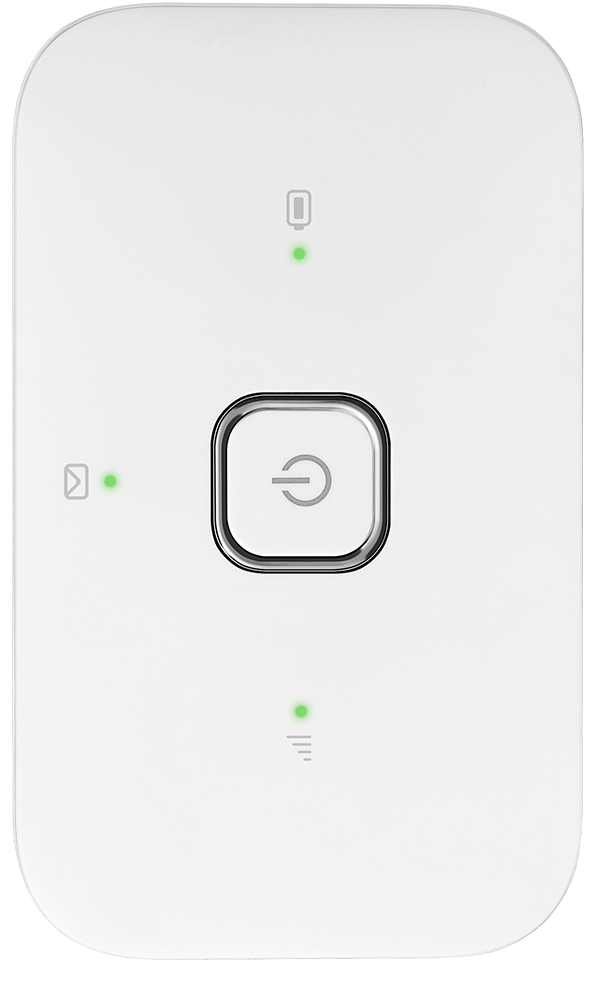
There is also another possibility. There are special devices now which are low powered and are specific designed to offer a WiFi connection to the Internet. The R218 is just one such device. It has it's own battery (like a mobile) so the charging options are pretty similar. It allows up to 10 devices to be connected directly so ideal for a small number of computers to use it.
Computers.
So now we have a way of talking to the 'net, we need to be able to gather and process the data. To my mind there is only one choice of computer system, and that is a Raspberry Pi. These are extremely low powered computers with a small footprint. They are incredibly cheap (£4-£5 each) yet they carry a lot of computing power and can turn to almost any task. Many of the Pi varieties come with a WiFi adaptor already built in. This means that they can already communicate with the internet access point. The only thing that we need to do is install whatever software is needed and provide power.
There is also the issue of data storage. Obviously some data can be thrown up into the cloud (I already have my own Internet servers available) but the amount of upload really should be limited. It's not like I'd be streaming video. The Raspberry Pi devices use a small SD memory card. Given that the operating system and software for the Pi only uses up around 1Gb, using something like an 8Gb memory card means that there is more than sufficient storage available. So some photos and video could be stored locally and retrieved when I visit the plot. Whereas still images and "triggers" could be uploaded immediately to the Internet. If necessary I could remotely request footage to be uploaded. For example if vandals made a mess of the plot, the still image triggers could be uploaded, these would be sent to my mobile phone, I could then request the rest of the footage before they wrecked the place or stole the devices.
A better option may be to have a central, hidden, system used purely for storage of the media. The image servers would send the files to the storage server. This means that the image servers would be less susceptible to any possible damage and could be easily replaced. The total cost of such servers, including the camera, would be less than £10.
Weather Station.
There are a number of options here. There are plenty small home brewed weather station hardware that is already on the market. These are ideally suited to this kind of setup.
Ideally there are a number of sensors that would be useful.
- Wind speed
- Wind direction
- Rain gauge
- Temperature (air)
- Temperature (ground)
- Temperature (greenhouses)
- Solar intensity measurement and UV.
- Barometric (Air pressure)
Wildlife/Security Cameras.
The Raspberry Pi has cameras. Of course here the main issue is that there is no kind of housing for the devices as they are intended for hobbyists to use, so either they need to be located in a dry area (Greenhouse?) or I'd need to build some kind of secure and rainproof housing for them.
There already exists software for these systems. They rely on taking periodic pictures and comparing them to a control image. If a significant portion of the image has changed then the system starts recording from that point.

Data Storage
Obviously not all data will be immediately transmitted to the 'net. As mentioned above, there needs to be an area where the data could be stored until needed later. The most obvious choice for storage would be a simple USB memory stick. Fortunately I have a goodly amount of those things hanging around spare.
Layout and positioning
The Internet connection and Storage Server should be located in a safe area. Ideally inside the shed where it would be locked away from prying eyes and thieving fingers. The WiFi connection is not really too much of an issue given that it will easily cover the are of the plot. It may even be sufficient to allow for cameras to be installed at other locations on adjacent plots. Perhaps one covering the Car Park and entrance way? I'd have to check with the plot holders in question. The only issue would be supplying the necessary power to said devices.